FASTENERS & DRIVES
SCREWS: MATERIALS, THREADS, HEADS AND DRIVES
Choose by base material, load and environment. Compare wood, drywall, metal, machine, structural and masonry screws.
11 MIN READ
IN THIS GUIDE
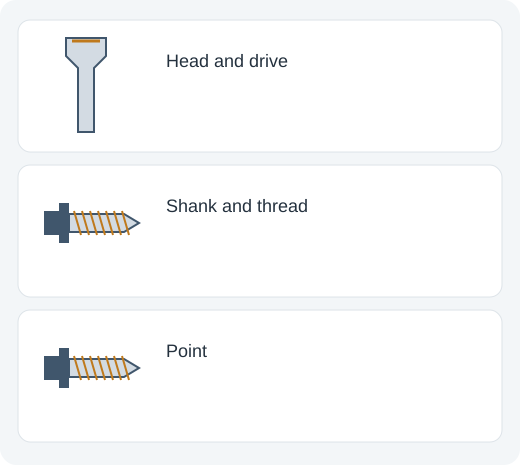
THE FIVE PARTS TO READ ON A SCREW
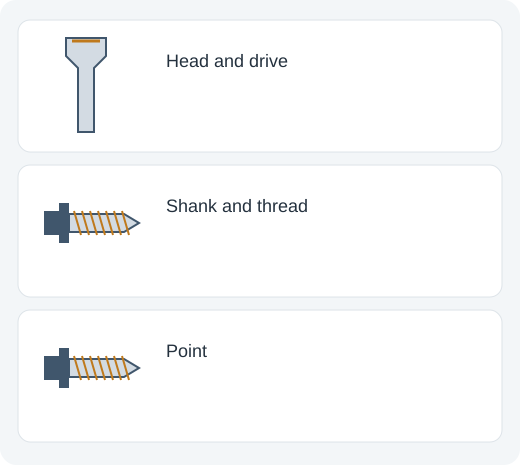
A screw combines a thread, a head shape, a drive profile, a tip and a material or coating. Each affects a different part of the job. The thread engages the base material or a matching threaded component; the head holds or clamps the attached part; the drive receives the tool; the tip affects entry; the material and coating affect strength and environmental suitability.
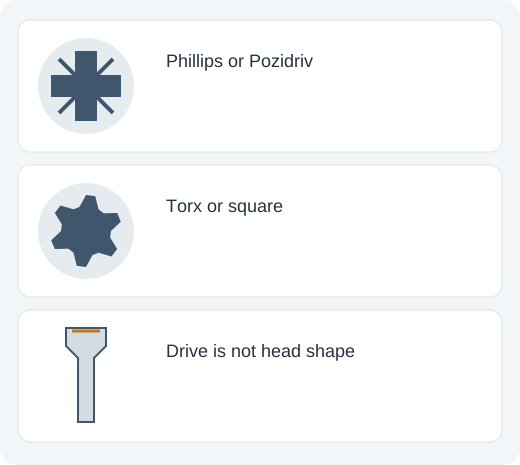
Head shape and drive profile are different. A flat countersunk head can use Phillips, square, Torx or another recess. A hex head is usually driven externally by a wrench or socket; a socket-head screw has an internal drive recess. Read the complete description rather than treating “flat-head” as “slotted.”
Start with what is being attached, what it is attached to, the required load and the environment. Then choose the approved fastener system and dimensions. A screw that goes into the material is not automatically suitable for the installation.
WOOD SCREWS, CHIPBOARD SCREWS AND CABINET SCREWS
Wood screws use threads intended to engage wood. Coarse threads and a pointed tip are common, but geometry varies. Some have an unthreaded section below the head that can help clamp one piece to another in an appropriate joint; others are fully threaded.
Hardwood, softwood, plywood, particleboard and MDF can respond differently. Pilot holes, clearance holes and countersinks may be needed to prevent splitting or create proper clamping. Use the fastener’s guidance and account for distance from edges and ends.
Cabinet and chipboard screws can use head and thread forms designed for particular panel joints. A small countersunk screw is not the right answer for every hinge or cabinet fitting. Confirm the fitting’s required head, length and diameter so the screw does not protrude or damage the panel.
DECK AND EXTERIOR SCREWS
Deck screws are intended for specified decking and exterior applications. Coating or material must suit exposure and the wood treatment. A bright indoor screw may corrode quickly outside, while some metals can react with treated timber or other metals.
Composite decking can need a dedicated screw and installation method to avoid mushrooming or damage. Hidden fastening systems use their own components and spacing rules. A conventional deck screw is not automatically interchangeable with them.
Exterior suitability is not the same as structural load approval. Follow the fastener and construction requirements for the assembly. Stainless steel, coated steel and other options have different corrosion and mechanical properties rather than one universal ranking.
STRUCTURAL SCREWS AND LAG SCREWS
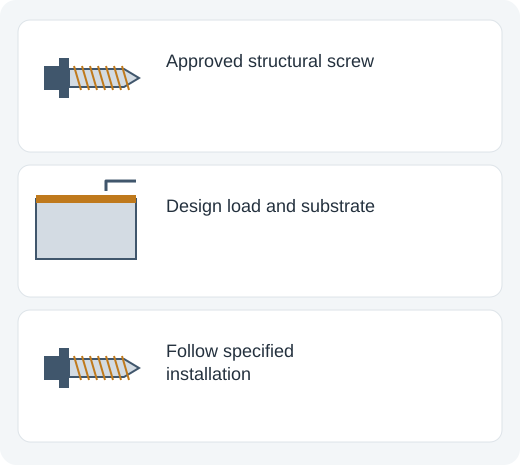
Structural screws and traditional lag screws are used in appropriate load-bearing wood connections when specified. Their required diameter, length, embedment, spacing, edge distances and installation method are part of the design.
A screw with a large head or an aggressive thread is not automatically structural-rated. Do not replace a specified structural fastener with a generic deck or drywall screw because the length is similar. Head bearing, strength and approved application matter.
Some structural screws have installation features that reduce certain preparation steps within their published limits. Others require pilot holes and additional procedures. Follow the exact fastener instructions instead of applying one rule to all products called structural.
SHEET-METAL AND SELF-TAPPING SCREWS
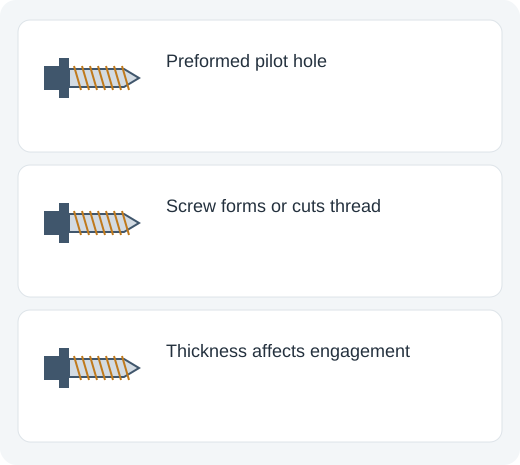
Sheet-metal screws have threads intended for suitable metal sheet or other specified materials. Many form or cut their engagement in a prepared hole. The required pilot diameter depends on the screw and material thickness.
Self-tapping describes forming or cutting a thread; it does not necessarily mean the screw drills its own starting hole. A pointed self-tapping screw can still require a pilot hole. Thickness, hardness and engagement length control whether the installation is suitable.
Choose a head that bears properly on the attached part. A pan, truss or washer head can provide different bearing geometry from a countersunk head. A head that sinks into thin sheet can damage the joint or reduce holding performance.
SELF-DRILLING SCREWS
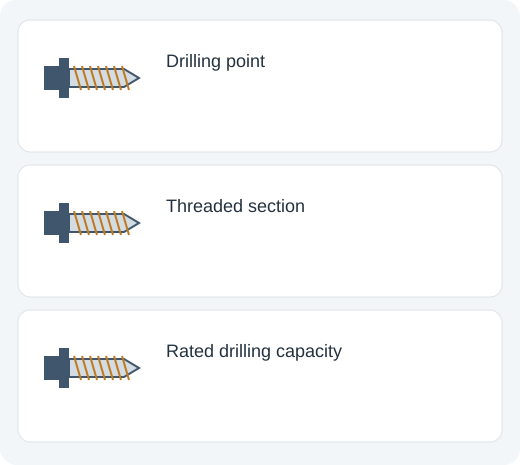
A self-drilling screw has a drill-like tip designed to make a hole within its specified material and thickness capacity. Tip number, cutting geometry and threaded engagement are product-specific. Not every drill-point screw works through every thickness of steel.
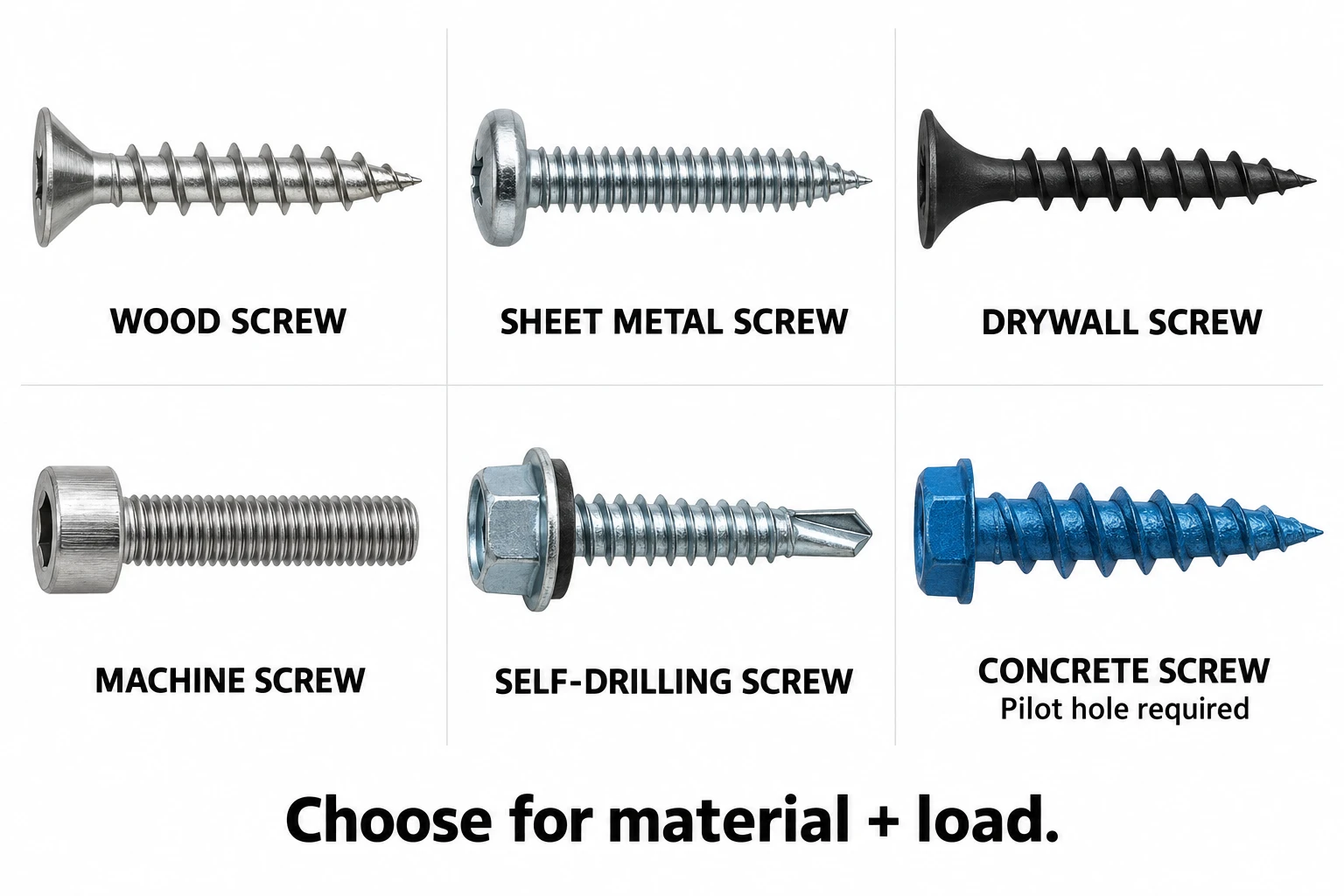
Distinguish the drill tip from a pointed self-tapping tip. The illustration shows the difference: a drill point has cutting features resembling a small drill, while a normal pointed screw does not. Use the screw’s rated drilling range and installation speed.
The screw must pass through the attached layers and establish sufficient engagement in the intended base. A tip that starts drilling does not prove the total screw length or thread range is adequate. Roofing and cladding screws may also require a compatible sealing washer and installation procedure.
DRYWALL SCREWS
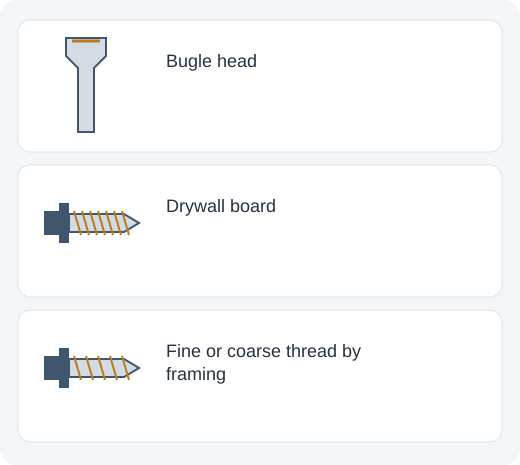
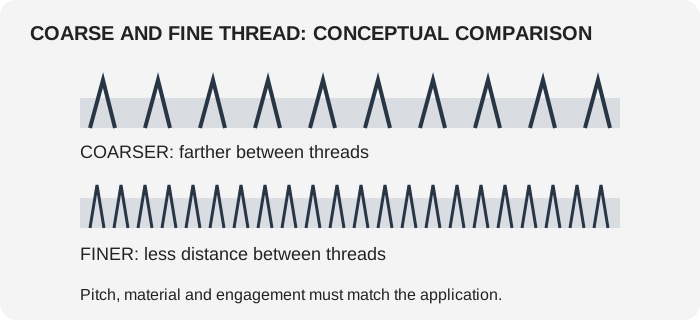
Drywall screws attach gypsum board to suitable framing within the intended system. Coarse-thread versions are commonly used for wood framing; fine-thread versions are commonly used with suitable light-gauge steel framing. Other steel thicknesses can require dedicated drill-point designs.
The bugle head has a curved underside intended to seat in the board surface appropriately. Overdriving can damage the paper and reduce holding. Use the correct fastening method, spacing and depth for the board and framing system.
Drywall screws are not general substitutes for structural wood screws. Their geometry, hardness and intended loading differ. A black finish often seen on drywall screws is not a universal exterior-corrosion rating, and ordinary drywall screws should not be assumed suitable for wet or exterior work.
MACHINE SCREWS AND BOLTS
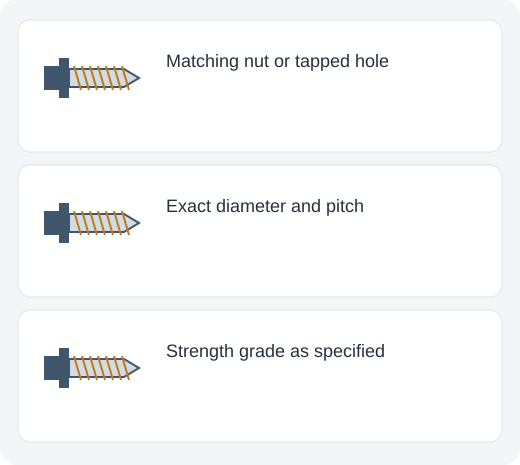
Machine screws use a defined thread that engages a matching nut or tapped hole. They commonly have a blunt end rather than a wood-screw point. Metric and Unified inch thread systems use different diameter and pitch conventions.
An M4 × 0.7 designation identifies nominal Metric thread diameter and pitch. Inch designations can identify nominal diameter and threads per inch. A thread that starts one turn in a hole can still be the wrong pitch or standard; forcing it can damage the mating part.
Strength class or grade, head style, length and material matter to the joint. For replacement, match the actual specification, not just the nearest-looking screw. Final tightening can require a defined torque, sequence or locking method.
CONCRETE AND MASONRY SCREWS
Concrete screws use a design intended for an approved base material and normally require a correctly sized pilot hole. Concrete, solid brick and block are different substrates; suitability must come from the fastener’s instructions.
Hole diameter, depth, cleaning, embedment, spacing and edge distance affect performance. A screw’s outside diameter does not tell you the required drill diameter. Use the specified bit and drilling process rather than selecting a close-looking size.
Repeated removal and reinsertion can change holding, depending on the product and base material. Do not assume unlimited reuse. For load-critical work, follow the approved fastening design and applicable installation requirements.
HEAD SHAPES AND WHAT THEY DO
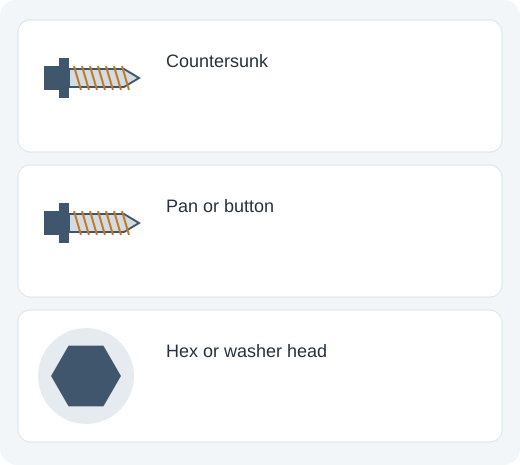
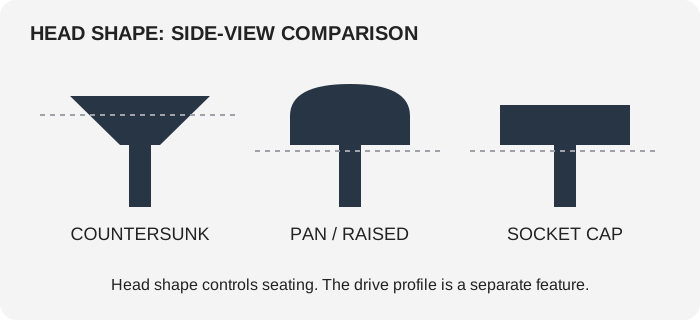
Flat countersunk heads are intended to sit flush in a matching countersink. Oval heads have a countersunk underside with a slightly raised rounded top. Bugle heads have a curved underside used in appropriate board applications. These are not interchangeable merely because all can appear low-profile.
Pan, button and truss heads sit above the surface. Truss heads typically provide a wider, lower bearing form; button heads have a rounded low profile. Hex and hex-washer heads provide external wrench engagement, and washer or flange forms change bearing area.
Socket-cap heads provide an internal drive in a cylindrical head. Cheese and fillister heads are other raised forms used in suitable assemblies. Choose the form required by the part: bearing surface, recess depth, clearance and countersink shape must all work together.
DRIVE PROFILES AND THE CORRECT TOOL
Common drives include slotted, Phillips, Pozidriv, square, Torx and internal hex. Security versions can add pins or use unusual shapes. Match the exact profile and size; a head shape does not decide which bit it needs.
For a hex external head, choose the correct wrench or socket opening. Thread diameter and across-flats wrench size are separate dimensions. A machine screw’s M designation does not tell you the bit size or socket opening by itself.
Use a suitable manual or powered tool and appropriate control. A correctly fitting bit can still overdrive a screw, strip the thread or damage the work. For specified tightening, follow the required torque or installation method.
LENGTH, DIAMETER AND THREAD ENGAGEMENT
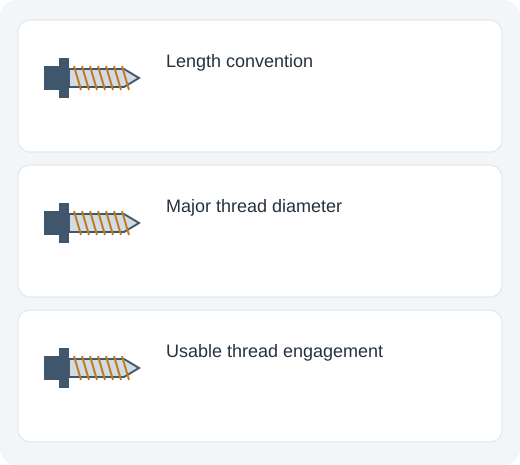
Length measurement depends on head form. Flat countersunk screws are commonly measured over the full length including the head; many raised-head screws are measured from under the head. Confirm the convention for the particular fastener.
Choose length so the screw engages the required base material without emerging into an unwanted area. The total assembly thickness, unthreaded shank, tip and required embedment all affect usable engagement. A long screw is not automatically a stronger joint.
Near an edge, too large a diameter or an unsuitable pilot can split wood or damage another substrate. In thin metal, too little engagement can strip. For designed connections, use the specified dimensions rather than a generic minimum thread-count guess.
MATERIAL, COATINGS AND ENVIRONMENT
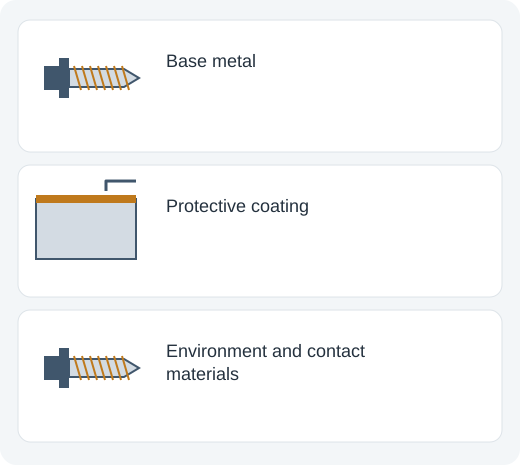
Carbon steel, stainless steel and other alloys offer different strength, corrosion and processing properties. Coatings such as zinc and specialized exterior finishes change environmental suitability, but a color alone is not a complete specification.
Match the fastener to moisture, chemicals, wood treatment and adjacent metals. Galvanic interactions can matter where dissimilar metals contact in an electrolyte. “Stainless” does not mean immune to every environment or automatically equal in strength to a specified hardened steel screw.
Use the approved material and coating for the job. Do not change fastener grade or lubricate a joint merely to make tightening easier without checking the installation requirements.
CHOOSING A SCREW: WORKED EXAMPLES
For drywall on wood framing, choose the screw type and length specified for that board system, commonly a suitable coarse-thread drywall screw, and control head depth. For a cabinet fitting, match the head and length requested by the fitting and panel material.
For thin sheet metal, decide whether a prepared-hole self-tapping screw or a rated self-drilling screw suits the thickness and joint. For concrete, use an approved concrete fastener with its prescribed pilot hole and installation procedure.
For a load-bearing wood connection, use the designed structural fastener system. The easiest screw to drive is not necessarily the correct one to hold the load. Material, head, thread, dimensions and installation must agree.
COMMON MISTAKES AND QUESTIONS
Self-tapping and self-drilling are not synonyms. Flat head and flat drive are not synonyms. Screw length and thread engagement are not the same measurement. A coating color does not establish exterior suitability.
Can one multipurpose screw cover everything? No. It can cover the applications in its specification, not every material and load. Can a drywall screw replace a deck or structural screw? Not merely because its dimensions appear similar.
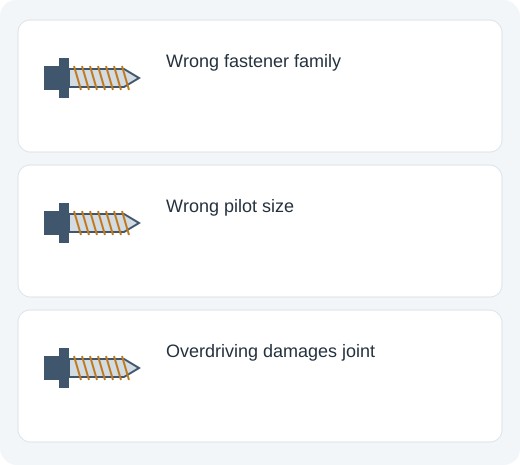
Why does a screw spin without tightening? The thread may be stripped, engagement too short, the pilot wrong or the substrate damaged. Why does wood split? Edge distance, pilot preparation, screw size and material condition can all contribute. Increasing driver torque does not solve those underlying problems.
A COMPLETE FASTENER DECISION FROM SUBSTRATE TO FINISHED JOINT
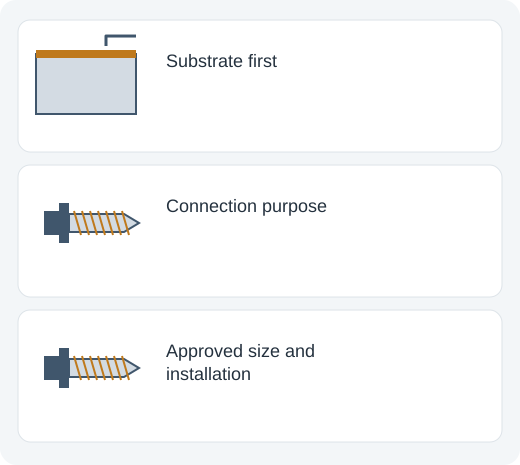
Begin with what the screw is joining and what load or function the joint must provide. A cabinet hinge, drywall board, outdoor deck board and structural ledger are different applications. Name the first material, the receiving material, the required appearance, the environment and whether the connection is structural. This prevents choosing a screw merely because its diameter and length seem convenient.
For wood, account for species, edge distance, splitting risk and the fastener’s pilot-hole instructions. For sheet metal, match the thread and point design to thickness and any prepared hole. For a machine-thread joint, match exact diameter, pitch and required strength. For masonry, use a fastener approved for the substrate with its specified hole preparation and embedment.
Next choose the head and drive. A countersunk head seats into an appropriate countersink; a pan or washer head bears against a different surface. The drive must match the bit exactly. Head shape affects contact with the work; drive geometry affects installation. Neither compensates for an unsuitable thread or receiving material.
Finally follow the installation method: pilot hole, drilling capacity, tightening torque or depth, spacing and any prescribed inspection. Check that the selected length provides the required engagement without penetrating an unwanted surface. For a critical assembly, use the specified fastener and procedure rather than substituting from an assortment because the replacement looks similar.
WHY DRYWALL, DECK AND STRUCTURAL SCREWS ARE NOT SUBSTITUTES
Drywall screws are designed to attach board to suitable framing with a head and thread appropriate to that task. Their shape and relatively easy availability do not establish structural load capacity for a different connection. A screw that drives successfully through timber has demonstrated drivability, not approval for a structural joint.
Deck screws often address outdoor exposure, installation and appearance in decking applications. Corrosion protection must suit the actual environment and contact materials. A coated exterior screw is not automatically approved for every treated timber, coastal environment or dissimilar-metal contact. Read the manufacturer’s application and corrosion guidance.
Structural screws are used according to published capacities, material assumptions and installation requirements for the approved application. Pilot-hole rules, edge distances, spacing and embedment can affect performance. Substituting a visually similar screw removes the basis for relying on those documented properties.
Keep these families labeled in storage and compare exact product specifications when replacing fasteners. Color, head diameter or marketing descriptions such as heavy-duty are insufficient evidence. Where a design specifies an approved screw, follow that specification or obtain an approved alternative rather than creating an equivalence from appearance.
VISUAL REFERENCE ATLAS
AT A GLANCE
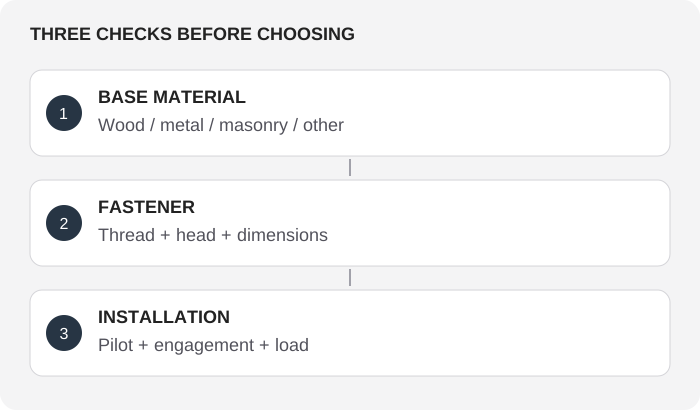
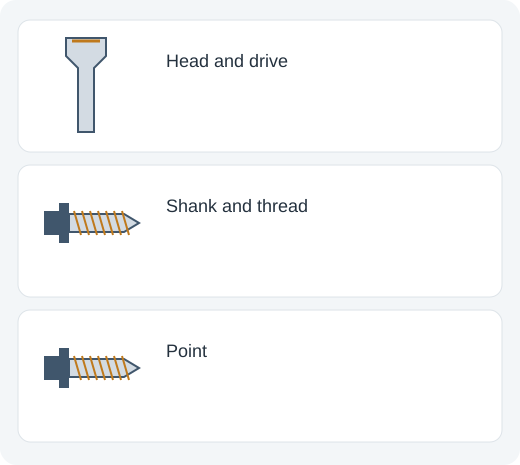
Illustrations explain the principle. They are not actual-size templates or precision fit drawings.
REFERENCES
General reference material. For an exact model, use its manufacturer’s specifications and instructions.
ScrewScrew driveISO metric screw thread