POWER TOOLS BASICS
BRUSHLESS AND BRUSHED MOTORS
Brushless describes motor construction, not a battery connector or compatibility standard.
8 MIN READ
IN THIS GUIDE
WHAT A MOTOR ACTUALLY DOES
An electric motor changes electrical energy into rotation. A drill then passes that rotation through gears to its chuck. A saw passes it to a blade. The motor does not do the whole job: battery output, electronics, cooling, gears, bearings and the working accessory all affect the result. Two tools with brushless motors can perform very differently.
The moving part is the rotor; the stationary part is the stator. Their magnetic fields push and pull against each other. To keep rotation going, the direction of the magnetic field must change at the right time. This switching is called commutation. The main difference between brushed and brushless motors is how that switching happens.
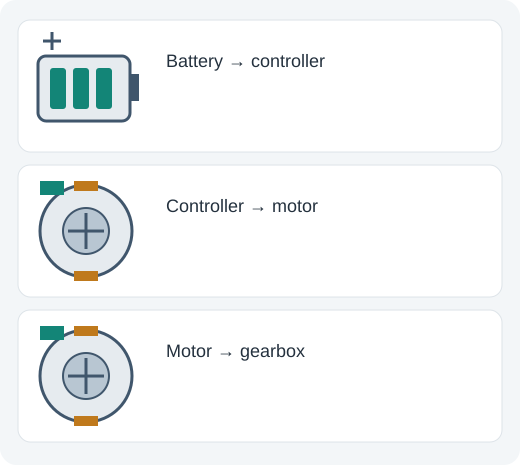
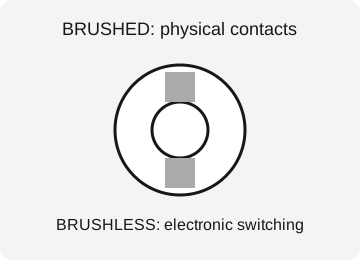
For a beginner, remember this: brushed describes mechanical switching with contact parts; brushless describes switching controlled by electronics. Neither word tells you the chuck size, working torque, speed range or what materials the tool can handle.
INSIDE A BRUSHED MOTOR
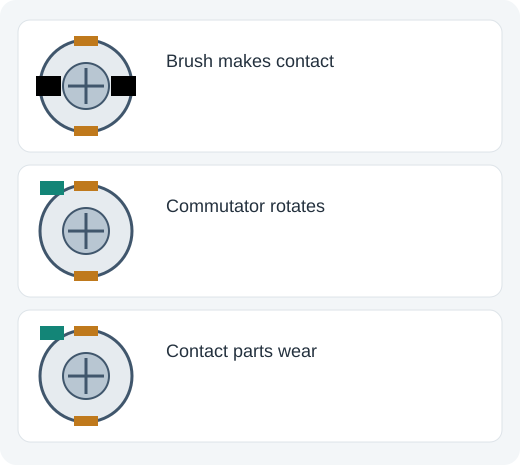
A typical brushed DC tool motor has carbon brushes pressed against a segmented copper commutator on the rotor. As the rotor turns, the brushes connect different winding sections to the supply. The switching happens automatically because the contacts move past the brushes.
Brushes are deliberately made to wear. They slide against the commutator, generating friction, heat and sometimes visible sparking. Some tools allow brush replacement; others are designed as sealed assemblies. A tool that slows down, smells hot or works intermittently may have worn brushes, but those symptoms can also come from bearings, wiring, switches or an overloaded accessory.
Brushed tools can be useful and economical, especially for occasional jobs. A well-built brushed tool with suitable gearing can be a better fit than a poorly specified brushless one. A lower price is not a reason to assume that its dimensions, accuracy or durability are inadequate for your task.
INSIDE A BRUSHLESS MOTOR
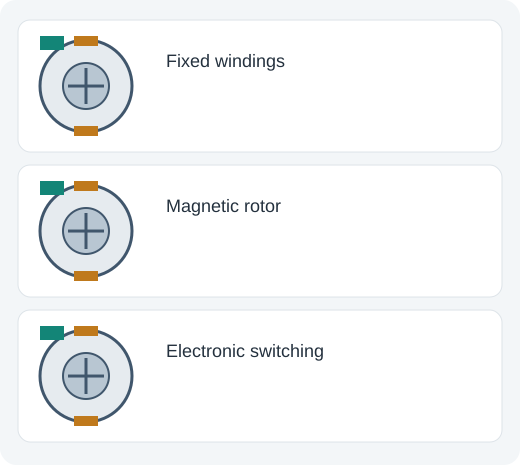
A typical brushless tool motor uses a permanent-magnet rotor and powered stator windings. An electronic controller energizes winding phases in sequence. Rotor position can be detected with sensors or inferred from electrical behavior. Both designs require a controller; “sensor-free” is not the same as having no electronics.
The controller can adjust switching and power delivery quickly. Tool designers may use that control for speed regulation, braking, overload protection and other functions. Those functions are separate specifications: do not assume every brushless tool has the same electronic brake, kickback response or thermal protection.
Without brushes rubbing on a commutator, there is no brush wear or brush-contact friction. There are still bearings, gears and electrical components that can wear or fail. “Maintenance-free motor” does not mean the complete tool never needs cleaning, inspection or repair.
EFFICIENCY, RUNTIME AND HEAT
Efficiency is the fraction of input energy that becomes useful mechanical output. Some energy always becomes heat through electrical resistance, magnetic losses, friction and electronics. A more efficient motor may provide more useful work from a given battery, but an exact runtime improvement cannot be read from the word brushless.
Imagine driving the same screws with two drills using identical battery energy. A more efficient system may complete more screws before charging. Now fit a much larger bit, change the wood species or hold the trigger at a different speed: the result changes. Runtime comparisons only mean something when the task, accessory, battery and operating conditions are comparable.
Brushless does not mean cool under every load. A stalled motor, blocked ventilation or an oversized accessory can overheat any tool. If protection stops the tool repeatedly, reduce the load and investigate the cause instead of repeatedly forcing a restart. Let a hot battery cool according to its instructions before charging.
TORQUE, SPEED AND GEARING
Torque is the twisting moment at a shaft. Speed describes how fast that shaft rotates. Gearing trades speed for torque: a drill’s low gear is normally useful for larger holes and demanding fastening, while high gear is useful for lighter, faster drilling. A powerful motor is not a substitute for selecting the correct gear.
Mechanical power depends on both torque and rotational speed. Maximum torque and maximum no-load speed are usually measured in different operating conditions; multiplying the headline maxima does not produce a trustworthy continuous power rating. Impact wrench fastening and breakaway torque also use different test methods.
A clutch, electronic torque setting and impact mechanism are different ways of controlling fastening. The presence of a brushless motor does not tell you whether a screw will stop at a precise torque. Use a suitable calibrated torque tool when the assembly requires a specified final torque.
CHOOSING A TOOL FOR REAL WORK
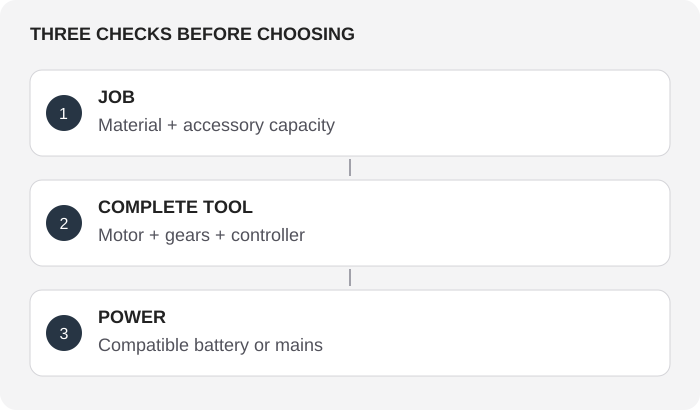
Start with the job: drilling, driving, cutting or grinding; the material; the working diameter; and how often you will use it. Then check capacity, weight with battery, physical access, controls, accessory interface and the manufacturer’s stated operating limits. Motor type is one part of that decision.
For repeated demanding cordless work, a brushless design can be attractive because of efficiency and control. For occasional light use, price and availability of a suitable brushed tool may matter more. For stationary work, a corded tool may solve the runtime problem better than buying extra batteries.
Compare the complete kit price, not only the bare-tool price. An existing compatible battery platform can change the practical cost. Check whether the included battery supports the tool’s intended output; physical compatibility does not guarantee identical performance with every pack.

CARE AND TROUBLESHOOTING
Keep ventilation openings clear and use the accessory intended for the material. A dull drill bit or clogged sanding disc can make a good motor appear weak. Clamp the workpiece, use the appropriate speed and avoid holding a stalled tool under power.
Disconnect power before cleaning, inspecting or changing accessories. Follow the tool instructions for lubrication and servicing; do not oil an electric motor merely because a bearing sounds noisy. Unusual vibration, smoke or a burning smell is a reason to stop and inspect the complete tool, not evidence that brushes must be replaced.
If output drops, check battery state and temperature, the accessory, the selected gear, the work material and ventilation. A controller that reduces output may be protecting the system. Repeated protective shutdown is a symptom to solve rather than a feature to defeat.
QUESTIONS PEOPLE OFTEN ASK
Does brushless mean more powerful? No. It describes the motor architecture. Compare suitable capacity and measured performance for the task rather than the label alone.
Does brushless mean longer runtime? It can improve efficiency, but task, pack size, cooling and operating speed also matter. There is no universal percentage increase.
Do I need to replace my brushed tools? A tool that safely meets your needs can remain useful. Replacement makes sense when its limitations, maintenance or platform costs matter to your work.
Is a brushless tool safer? Safety depends on the complete design, its protection functions, the accessory and how it is used. Brushless is not a safety certification.
FOLLOWING ENERGY THROUGH A REAL DRILLING TASK
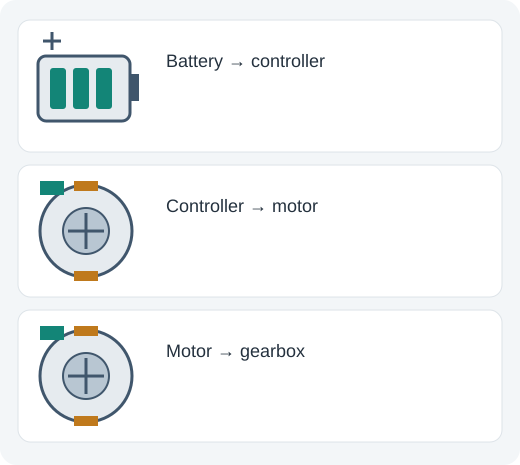
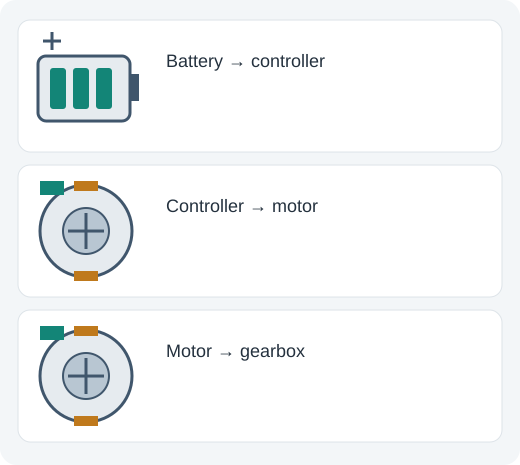
Imagine drilling a series of holes in thick timber. Electrical energy starts in the battery cells, passes through pack protection and tool electronics, becomes magnetic force in the motor, and reaches the bit through the gearbox and chuck. At every stage, some energy becomes heat. A brushless motor removes brush-contact losses, but cannot remove friction in bearings, electrical resistance in the windings, gearbox losses or the work required to cut wood.
When the bit enters the wood, the load rises. The controller responds within the tool’s current and temperature limits. If the operator pushes harder than the bit can cut, speed may fall and heating may rise. The useful response is not automatically a larger battery or a more expensive motor: check the bit geometry, chip evacuation, speed setting and whether this drilling diameter belongs within the tool’s intended use.
Compare two tools on the same task rather than comparing the word brushless on their boxes. Use the same suitable bit, workpiece, battery condition and operating technique. Record completed holes, handling effort, reaction control and interruptions for cooling. This tells you more about practical productivity than unloaded speed or a manufacturer’s maximum torque number measured by a different method.
A tool that stops under overload may be protecting itself; that does not identify the faulty component. Release the trigger, remove the accessory from the work safely, let the system cool if required and consult the instructions. Repeatedly defeating or immediately retriggering a protective stop can turn a correct protective response into overheating or accessory damage.
HOW TO COMPARE LISTINGS WITHOUT OVERREADING THE MOTOR LABEL
First identify the operation: controlled screwdriving, general drilling, masonry drilling, cutting or grinding. Next read the tool’s operating ranges, holder type, weight and dimensions with the intended battery installed. Only then compare motor design. A compact brushed tool can be a better practical fit for occasional confined-space work than a larger brushless tool designed for prolonged heavy loading.
For sustained work, look for information about cooling, duty limits, service support and overload protection. For delicate fastening, prioritize low-speed control, clutch behavior and a suitable bit. For awkward access, head length, handle position and center of gravity may dominate the decision. Brushless describes an internal switching method; it does not answer these application-specific questions.
Use manufacturer runtime claims as comparisons only when the task, accessory, pack and test conditions are provided. Twice the claimed number of screws in an unspecified test does not establish twice the runtime on your project. Battery capacity and motor efficiency are contributors, while fastener dimensions, wood species, pilot holes, temperature and operator technique also change the energy needed.
After purchase, keep air paths clear and use accessories that cut or drive efficiently. Do not lubricate a motor housing or open a sealed assembly merely because a tool sounds different. Compare the symptom with the service documentation: worn gears, bearings, brushes in a brushed motor, a damaged battery or an incorrect accessory can each produce different problems.
VISUAL REFERENCE ATLAS
AT A GLANCE
Illustrations explain the principle. They are not actual-size templates or precision fit drawings.
REFERENCES
General reference material. For an exact model, use its manufacturer’s specifications and instructions.
Brushless DC electric motorCommutator (electric)